Showing posts with label Taoism. Show all posts

A Journey of a Thousand Miles Begins With a Single Step - #Beleive

Tao Te Ching
The quotation is from Tao Te Ching (Chapter 64) which is attributed to Lao Tzu - 千里之行,始於足下 - Qiānlǐ zhī xíng, shǐyú zú xià literally it is A journey of a thousand li starts beneath one's feet. A beautiful statement with optimism and hope. Irrespective of our position, status - social, financial, relationship or anything else, it is looking about where we are, right here , right now, accept it, no looking behind, leaving the past where it belongs. Be in the present, observe it, take a decision and take it forward which begins with a single step.

The statement itself offers wide range of outlook in variety of situations we face day-to-day. Certainly it is not meant for traveling but emphasizing the 'first-step' as the one that counts. In the statement we have a counterpoint between 'thousand miles' and 'single-step'.
BBC's  Learning English - Moving Words clarifies :
The rhythmical parallelism is reinforced by the contrast in vowel length and consonant sonority: note especially the long vowels and liquid consonants in 'miles', and the short vowels and plosive consonants in 'step'. The force of this quotation lies in its final word. 
    

It offers hope, guidance, encouragement to anyone who is in a difficult path, specially in a temptation of giving up or in hesitation to start something. Being aware of what is beneath  our feet and what's at the destination point, which may be literally thousands miles away, will help us to guide where to place our foot with that 'first-step' and all the others that follow.

Beleive
Photo by erik cid on Unsplash

The Step before the First-Step


When Philosophy meets Psychology that 'first-step' begins with believing .Are we really believe that when we take a single step we come closer to our destination? Are we comfortable to take it forward with a single step? Certainly these philosophical statements give desired outcome when act from our core psychological stand point- which is called belief. And it varies obviously person to person.

What do we mean by Belief ?


If we go by dictionaries, we get some definitions of belief. let us see what it is

Cambridge Dictionary :  the feeling of being certain that something exists or is true

Collins Dictionary : Belief is a feeling of certainty that something exists, is true, or is good.  

Oxford Dictionary :  An acceptance that something exists or is true, especially one without proof.

            Something one accepts as true or real; a firmly held opinion.
            A religious conviction 

If we observe closely with the definitions and the explanations, we find some interesting words in order to understand how belief works. 
  • Opinion
  • Truth
  • Confidence

Confidence in the truth of existence of something not susceptible to rigorous proof  - basically takes us closer to assumption.  Basically we assume that something is true before we have proof.

When do we consider something as True ?


A very simple question if we ask ourselves when we watch news in the TV. Do we believe it?  A series of typical observation will derive when we search for the answer.  Each of us believes it differently - some believe in full , some believe partially or some believe it only when it come from the mouth of a trustworthy person. And interestingly trustworthiness of a person also varies widely among the  followers . If I consider her / him trustworthy, it does not mean that my friend agrees to consider her/him trustworthy.

What is the Proof of a Truth


Is it possible for me to prove that it is 10 o' clock by just seeing my watch. If I doubt it I may check with the computer or mobile phone. If I doubt even that I may call a friend to get the time correct.  Now the question is, is this exercise prove me the time is true? No, because I am still believing it.

It is our beliefs - they become self-fulfilling prophecies. Beliefs are sometimes divided into core-beliefs ( that are actively thought about) and dis-positional beliefs  (that may ascribed to someone who has not thought about the issue).       
Take this even further , what happens to our brain when we make up a belief - simply we assume it true without having the proof.

The moment we generate a belief, our consciousness creates  new probabilities in our life. New probabilities lead to new realities. Even if we are not aware of this, we have opened a new avenue into a reality that contains the probabilities of manifesting exactly what we believe. 

It is something like Radio frequency, to catch it we have to wait until it finds its resonator.  The moment the resonator is found it will transform from a possibility into reality, which means our belief just manifested.

How Quantum Physics explains Consciousness

The illusion of matter becomes more obvious and the realization that nothing is independent from each other and more conclusive. Dualism is  the concept , Quantum Physics can lead us to new paradigm in consciousness.

Dualism

Our consciousness is programmed with basic concept of dualism. Either it is this way, or it is the other way. Ether it is good or it bad, true or false, hot or cold etc etc. Everything in the nature have its complementary opposite in the very nature. So when we look closely, we will find the concept of duality.   
Dualism and matter, both concepts are sometimes most of us fail to understand that these are the concepts , because of their vastness.

With no further detailing we can easily say Dualism takes the important role to decide whether an event is true or false. Then what we say about truth. When every concept leads to an experience and by experiencing it we can fulfill its purpose.

I am here linking a real-time report with a video inserted into it 

Watch: Policemen surround dying man at anti-Sterlite protest, tell him to ‘stop acting’


which critically explain how dualism plays a very crucial role to understand an event as true or false.

An experiment by tossing a coin we can observe quantum experience- How ?
Let me toss a coin with a condition to decide whether I go to meet someone or not. By taking the coin in my hand I already know there are two possible outcomes. Either it will end up with head or with tale.

Based on the result outcome, I have to choose meeting the person or not meeting the person. If I have to choose not to meet the person. But the other time line still exists in the parallel universe that is I am meeting the person. I just focused my attention on one of the universe by taking a decision.


Time

Let us consider if we do not take a decision. It is a very difficult task for our mind and it requires some training, but we are capable enough not to take a decision.  We are able to have our attention in a consciousness superposition, where both worlds are present at the same time. It means at the same-time I am meeting the person and not meeting the person. It is very clear that our mind is not trained to grasp the idea.

Quantum Superposition


Time does not exist in quantum superposition. In this case a light can be on or off at the same-time, because both are real in two different world of consciousness. If we look into a moving object and experience it seemed to freeze. Think of a second tale of a watch, when we observe the second tale is not moving suddenly we understand it is actually moving.  But when we observe the tale is not moving, the state is called quantum superposition. By practicing, the state can be expanded and we can experience superposition.

It is the first step of believing with creative consciousness. It is like a completely new topic which never came to us before.

A creative response to live is faster than any decision we can make up. We decide based on past experiences.

A result based on computer analysis is on the data we feed into it. It comes up with the past data which were available to the computer to analyze. It does not consider the present moment. Therefore it is always limited.

It is obviously a superposition, when we are able to allow our consciousness to take a decision on the very moment but not considering on the past data.

This is what we call believing, Thus believing is the first step of thousand miles paradigm.

Can a simple belief create a reality in our life ?

  
It is actually possible to do that - by controlling the quality of our thought. Our thought is a form of vibration, rather a combination vibrations of different frequency. Here we can conceptualize pure thought over contaminated with different thoughts comes to our mind at a given time.
Lets go back in 1937,  when Napoleon Hill originally published his book Think and Grow Rich, everybody wanted to know how manifestation changes thought to reality. In other words, everyone wanted to know the formula of Law of Attraction . It is actually

Desire + Belief + Expectancy + Action = Manifestation.
   
Napoleon Hill explained :

When faith [by which he meant belief] is blended with the vibration of thought, the subconscious mind instantly picks up the vibration, translates it into its spiritual equivalent, and transmits it to the Infinite Intelligence, as in the case of prayer.


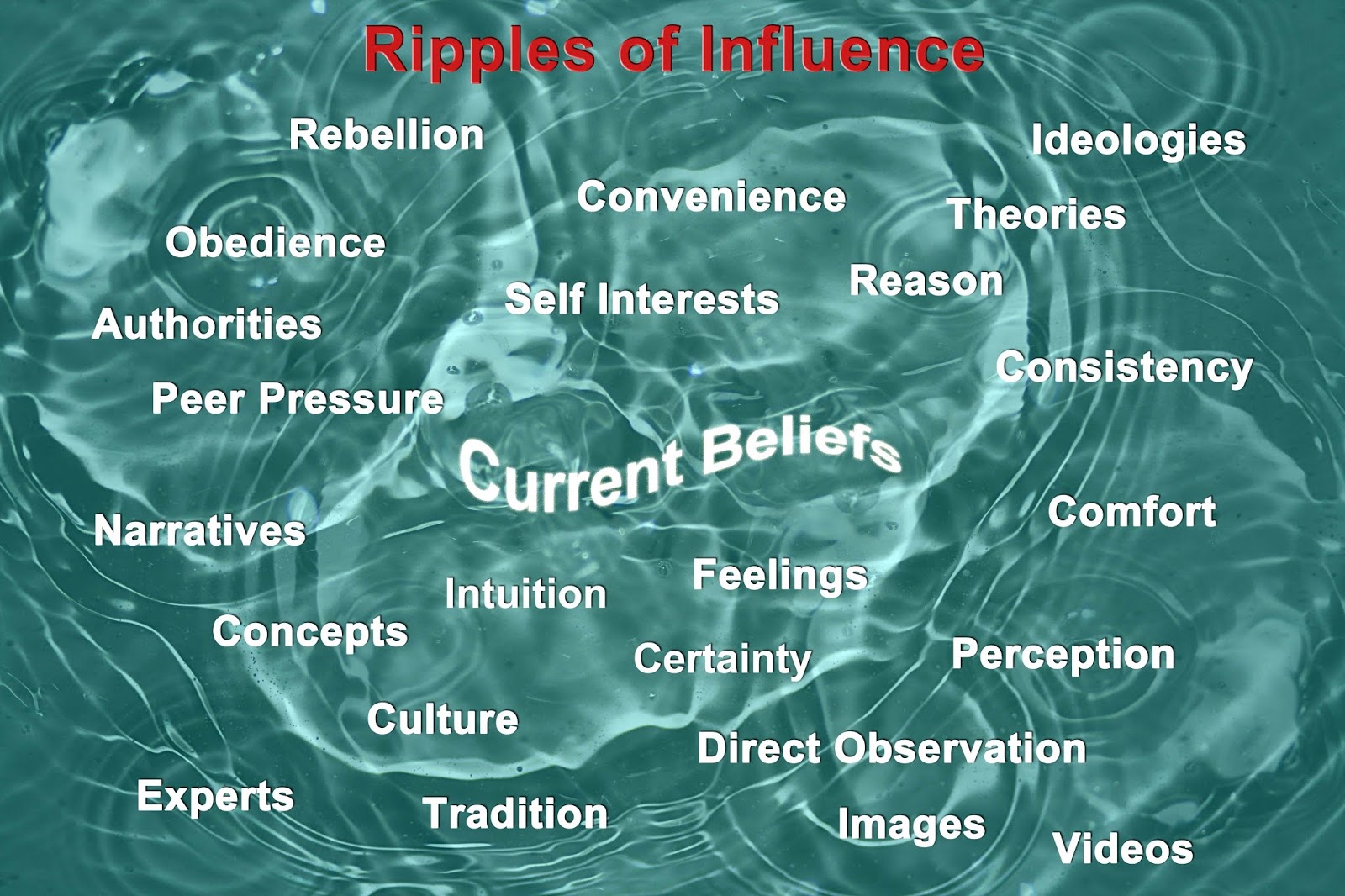
Let us consider an analogy of a swimming pool where a man is standing at waist water level at  one side of the pool. There is nobody in the pool. The water is absolutely still. He makes a wave in the water by one of his hand. He observes the wave goes gently towards the sides and ends there and little form of return wave is formed. Then few more people jumped into the pool and started swimming. Then imagine what will happen if he tries to make another wave.
Partha Bose
Ripples of Influence By User:Lbeaumont based on image by Mila / Brocken Inaglory - This file has been extracted from another file: Multy droplets impact.JPG, CC BY-SA 3.0, https://commons.wikimedia.org/w/index.php?curid=29111316

The second condition is the real analogy to explain our thoughts at any given point of time. Which is called ripples of influence in our mind. That mind is responsible for our entire thought process. It is quite clear that if we take a single step, we practically need to clear our pool of thoughts and proceed for A Journey of a Thousand Miles Begins With a Single Step.

Any thought arises in our brain is simply an energetic process and the energy can be converted into physical reality by consciously monitoring through our belief.


When we decide to believe , reality takes its form instantly.     


How The Movie Rock On and it's Sequel encompass the essence of Taoist Philosophy

Essence of Taoist Philosophy
Rockers of Rock On

I recently watched Rock On and Rock On 2. Interestingly Rock On was released in the year 2008 but I could not watch the movie for no apparent reason. I somehow was able to watch the movie only at the end of 2017. And day before yesterday I watched it's sequel Rock On! 2. I am now happy that I didn't had to wait 8 years to see how the Rock Band MusiK would be doing after the rocking performance in 2008.

Taoism and Rock On , how are they connected ?


Taoism
Dreamers of Rock On
Choosing Rock On or Band Musik as a subject matter while discussing Taoism is something that cannot be explained in a sentence but require detailed explanation. Rock On , it is not about music or always about singing. Since the beginning of the Rock Band Musik faced an emotional high low pattern on it's journey with songs , lyrics, music that spoke about a generation, about love, about growing up and finally quite uniquely chasing dreams; misunderstanding between Joe, the lead guitarist and Adi, the lead singer during filming a music video, leave a note of disband Musik and its members including Kedar a k a KD(Killer Drummer) and Rob who plays Keyboard become estranged. But the Rock Band Musik remains alive in the dreams of it's members for 10 years. This is the talking point for me now.

While studying Taoism we can find relativism in a vivid context in the text Chuang-Tzu. It is truly a Chinese classic - a text with rich allegories emphasizing the ever changing but always the same nature of life..It talks about the tendency of moral relativism and descartian struggle with sensory perception.

An example of relativism came in as happy dead. Judgments about right or wrong by necessity are made from a specific point of view .Thus, sometimes people who observe the same phenomenon arrive at different conclusions about it. It is also impossible to decide on the relative merit of these different perspectives. As a solution the Chuang-Tzu suggests a higher point of view  which remains impartial in its attitude towards all the view points. They are all treated as equally valid or perhaps equally invalid. It follows that life is desirable and preferable to death; a perspective that comes only from the point of view of the living.

An example of the Chuang-Tzu struggle with the sensory perception appears in the dream of butterfly


Essence of Taoist Philosophy
Photo by Timo Vijn on Unsplash

Long ago, Chuang Chou  dreamed that he was a butterfly. He was elated as butterfly - well pleased with himself, his aims satisfied, he knew nothing about Chou. But shortly he awake and found himself to be Chou.He did not know whether as Chou he dreamed he was a butterfly or whether he actually was a butterfly who now dreamed he was Chou.


If a sleeping person can dream so vividly that he is unable to ascertain that his experiences are actually unreal, how can he ever be certain that anything he experiences is real? Unlike Descarte's attempt to use logic to verify his sensory perception, Chuang Chou responds with a Taoist acceptance of the conundrum and prefers not value the dream as any less real than the waking state and vice versa. It suggests that all natural life and all experiences are in essence interchangeable. A butterfly's existence as valuable and meaningful as an experience one has while awake. 

The team members, after breakup dreamed so vividly (as Chuang Chou) that they came together and reunited as Musik Rock Band.

Essence of Taoist Philosophy
Prachi Deasi


Here Sakshi (Adis.s wife) and KD took the important role of reuniting the members. KD's expression all along the journey make me amazed in this part of the movie.


Essence of Taoist Philosophy
Purab Kohli


As far as the story goes it confirms that it is not only for the music but it's about holding on to what makes them alive by responding their inner sense, call from heart. 


Taoism
Arjun Rampal and Farhan Akhtar

Chapter Three of Tao Te Ching


By not adoring the worthy, people will not fall into dispute.
By not valuing the hard to get objects, people will
not become robbers.
By not seeing the desires of lust, one’s heart will
not be confused.
Therefore the governing of the saint is to empty one’s mind, substantiate one’s virtue, weaken one’s worldly ambition and strengthen one’s essence.
He lets the people to be innocent of worldly knowledge and desire, and keeps the clever ones from making trouble with their wits.
Acts naturally without desire, then everything will
be accomplished in its natural order.
     

Rock On 2 


Essence of Taoist Philosophy
Musik the Band

It comes in a dream note in a different form with reality shows and music clubs , rich clients and poor musicians. Joe is the owner of the music club.

Then Meghalya enters the scene. In five years of bearing the guilt of having caused a musician Rahul suicide through not giving him the time, Adi kept himself exiled . He build a school and form a cooperative society of farmers and built a very rational and friendly relationship in the area.

The trio and their families reunite in Meghalaya for Adi's birthday and they decide to reassemble their once famous band.

After that, a tragic disaster in the form of forest fire destroys the village that Adi adopted.

Taoism
The Last Hurdle - Shraddha Kapoor and Farhan Akhtar


Here the new character Jiah Sharma enters in the story. Eventually she is the sister of Rahul. Jiah is also carrying the burden of her brother's death and her father's hatred for fusion music.

With the fund raising plan for the support of the villagers the Band come back in full swing.


 Chapter Four of Tao Te Ching.


Tao (the way) can be infused into the nature and put to use without being exhausted
It is so deep and subtle like an abyss that is the origin of all things.
It is complete and perfect as a wholeness that can.
Round off sharp edges;
Resolve confusion;
Harmonize with the glory;
Act in unity with lowliness.
Tao is so profound and yet invisible. It exists in everywhere and anywhere.
I do not know whose Son It is, It is existed before heaven and earth.

 
Taoist philosophy in many ways is much more flexible than Confucianism. Taoist writers seek to avoid being guided by rules and definitions. They encourage more intuitive ways of seeking balance in the world by resisting desire to interfere with normal process of nature. Taoism emphasizes Wu Wei - en-lighted non-action  rather than needless bustle and busy work for it's own sake.

Life is as miraculous as it is in Rock On and it's sequel . In both cases music have become the energy line which flows into Rock Band Musik to the heart of the audiences. At the end of the day it proves that music is the metaphor of life.


Usha Uthup and the Shilong Band SummerSalt should be given special mention for their beautiful performance for Hoi Kiw/Chalo Chalo in a terrible circumstances. The song has changed the sequence and made the environment easy for Musik to rock on.


Tao Te Ching
Rock On Blasts


 Chapter Six of Tao Te Ching


Spirit of the valley is immortal.
It is called the mystic nature.
The gate of the mystic nature is regarded as the root of the Universe.
It is everlasting and cannot be consumed.

 Norman Giradot explained the internal alchemy of Tao as

The whole thrust of Taoism has always been in terms of healing methods that seek to re-establish the original balanced wholeness of human nature and society.   

Final Thought


Taoist ethics are more concerned with becoming a good person than doing good acts. That good person lives in harmony with all things and people.
Taoist ethics are inseparable from Taoist spirituality- both contain the same ideas. In the context of Tao, Taoists try to see what would be best suited with natural order of things.
To summarize, Taoists tend not to initiate action- but wait for the events to make action necessary- and avoid letting their own desires and compulsions push them into doing things.

Here the story line of Rock On matches the essence of Taoist Philosophy. I hope Rock Band Musik will take their journey forward and make some more sequels in order.

I would love to quote Tao Te Ching again.

Chapter Fifty Four


One who cultivates himself with Tao,
Firmly establishes his virtue.
He holds on faithfully to the Great ones,
And honored for generations ever after.
Cultivate oneself with the Oneness, Tao and the virtue is genuine.
Cultivate a family with  the Oneness, Tao and the virtue is in surplus.
Cultivate an entire village with the Oneness, Tao and the virtue is enduring.
Cultivate a whole nation with the Oneness, Tao and the virtue is luxuriant.
Cultivate the whole world with the Oneness, Tao and the virtue is universal.
Hence, by cultivating oneself, thus gains insight into one's true virtue.
By cultivating a family, thus gains insight into a loving family.
By cultivating a village, thus gains insight into a harmonious village.
By cultivating a nation, thus gains insight into the extensive benefits for the people.
By cultivating the whole world, thus gains into the universal peace that embrace all beings.
How do I know that the world is so ?
It is through this way.
      
Taoism requires human beings to be humble and to recognize that  not only they are not obliged to make the world  a better place, but they should actually be ignorant of what is really happening, and that they are likely to make things worse if they do take any action. 

Rock On Final Song


Rock On 2 Final Song


The Wisdom of Wei Wu Wei a Secret Art of Non-Doing

Art of Non Doing

Wei Wu Wei literally means action through inaction. There are large numbers of interpretation are floating around the corners from the Universities, philosophical studies to internet blogs.
Photo by Rob Mulally on Unsplash

Overview Wei Wu Wei


A couple of years back I read Lao Tzu's Book Tao Te Ching . After first reading I must confess that I could really understand anything about the philosophy of  non-doing but it kept me amazed. I had searched other sources from the internet and read the book once again without much of a result. And I started loosing interest on the subject. I never thought that I would ever try to go through the philosophy again. But the theory itself started reflecting  in my mind for which I had not put much of a thought. This is the beauty of Wei Wu Wei. This is the paradox . It is acting without acting, doing the things that we admire, we can find flow in. By going with this flow , we reach the state of non-doing.

Wei Wu Wei literally means action through inaction. There are large numbers of interpretation are floating around the corners from the Universities, philosophical studies to internet blogs. But I am trying to elaborate here my experience during my journey towards  the idea of Wu Wei in order to refine the central idea of Taoism. This is the art of effortless action as described in Taoist teachings.

In our day to day activities we act, try to act lot of things in order to live. Wei Wu Wei is about knowing when effort is needed, appropriate and when it's fruitless or wasted. It does not mean like cooking, cleaning, caring , doing official jobs, checking emails etc. we do not do but sit idle. If we minutely observe and reflect we can easily see some valuable things in life which cannot be achieved by pushing harder. They are merely self defeating.
Art of Non Doing


The idea of Wu Wei is a part of Taoism whose central philosophy is known as The Way. Written in China 600 B C in the Tao Te Ching the idea of Wu Wei is first described as
do that which consists in taking no action and order will prevail.

When things get challenging in life we can check that if we can practice Wu Wei. In state where we loose self consciousness, the self and environment merges into one. We should not confuse ourselves that we are stuck in a singular state of mind. The state of Wu Wei is always moving and flowing.

Chinese Painters during the Tang period and onward tried to put the ideas into their paintings. The flow that is achieved during the acts, arts.


Art of Non Doing
Terence James Stannus Gray -  In 1958, at the age of 63, he wrote and published the first of the “Wei Wu Wei” titles

Terence James Stannus Gray (14 September 1895 – 5 January 1986), better known by the pen name Wei Wu Wei, was a 20th-century mystic, Taoist philosopher, and writer. Between the years 1958 and 1974 he wrote eight books and penned some articles which featured in various periodicals under the pseudonym 'Wei Wu Wei'  

During my study of Wu Wei I eventually came across Terence Gray. Apart from his writing his life story made me amazed.

He was born in Felixstowe England  in a well established Irish Family . An Oxford University graduate Terrace Gray was interested in Egyptology in early life and pursued scholarly education on the subject.which culminated in the publication of  two books on ancient Egyptian history and culture in 1923. He was then involved till 1940 as theorist , theatrical producer, creator of radical 'dance-dramas', publishers of several related magazines and author of two books.   He was a major influence on many noted dramatists, poets and dancers of the day, including his cousin Ninette de Valois, founder of the Royal Ballet (which in fact had its origins in his own dance troupe at the Cambridge Festival Theater which he leased from 1926 to 1933).
He also maintained his family's racehorses in England and Ireland. 

In the decade 1940s he apparently lost his interest in drama ,theater and turned towards Philosophy and Meta-physics. That time he traveled throughout Asia and stayed sometime in the Ashram of Ramana Maharshi ,Tiruvannamalai , India.   In 1958, at the age of 63, he wrote and published the first of the “Wei Wu Wei” titles . In the next 16 years he wrote seven subsequent books, including his final work under the further pseudonym “O.O.O.” in 1974. During most of this later period he maintained a residence with his wife Natalia Bagration-Imeretinsky in Monaco. He is believed to have known, among others, Lama Anagarika Govinda, Dr. Hubert Benoit, John Blofeld, Douglas Harding, Robert Linssen, Arthur Osborne, Robert Powell and Dr. D. T. Suzuki. He died in 1986 at the age of 90.

One of his famous writing is 
The ocean moves, not because it wishes to move or because it knows that it is wise or good: it moves involuntarily, unconscious of movement. It is thus that you also will return to Tao, and when you have returned, you will not know it, because you yourself would have become Tao.
While I go by his life and creation , I observe the shifts his actions of inaction moved involuntarily. Terrace Gray is happened to be significant contributor in the study of Wu Wei in the Western World.

Wu Wei is the flow of energy , life energy, energy of creation and energy of destruction, energy of being and energy of non being, male energy and female energy, positive energy and negative energy . Here idea of Yin-Yang derives. This is the essence of Qi, the vital force of any living being.
Wu Wei
Symbol of Yin-Yang

What are Yin and Yang


In the Chinese perspective, given the importance of  
taking everything as a whole
all things are relative. A thing can be understood only in relation to something else. This is the essential concept of Yin and Yang.
 
Yin and yang are terms used to describe relative opposite qualities or manifestations of Qi. If yin is form, then yang is function. If yin is material, then yang is immaterial.

  •  Yin refers to aspects or manifestations of Qi that are relatively material, substantial, condensing, solid, heavy, descending, cold, moist, cooling, dark, passive and quiescent.
  • Yang refers to aspects or manifestations of Qi that are relatively immaterial, amorphous, expanding, hollow, light, ascending, hot, dry, warming, bright, aggressive, and active.

The Wisdom of Wei Wu Wei

Wu Wei essentially have 2 key principles and 5 Secrets


The Principles


1 Be mindful of Flow

Observing our surrounding. being the witness are the key perspective of being mindful. What we eat, what we do, what is or was the time, what we see or saw, everything that comes to our sensory limit. The observations are endless. As soon as we start observing we can easily feel that area of our surrounding appears bigger when we take outward journey (Yin).
In contrary when we observe our body and take to more inward then we reach at subtle state of the mind and to  the Soul (Yang)

2 Don't Force it


The essence of the Wu Wei is to go with the flow not against it . We should not be hard and we should not have to force it.
Sometimes things appear to be stagnant and bad fit.We struggle beyond belief in something. Perhaps that is a sign that we need help. Or maybe we should simply focus our efforts elsewhere or in a different way. This is especially true if there are things in our life that already put us in a state of flow.

Of course finding flow does not just happen. It is as much Science as it is Philosophy. The key is finding balance between difficulty and skill. so adjusting these two variables may help get us there.


The Secrets


Art of Non Doing

When we are at the alignment to the source. the Tao, then we do not have to anything. This is not to be confused with doing nothing. Instead it describes inspired action  with life energy., dedicated actions to a purpose towards Oneness. 
 Photo by Alex on Unsplash

1 No action is not equal to Nothing Happens

Lao Tzu states
The Tao does nothing and yet nothing is undone

Action-less action is considered  the natural way to do things, as opposed to striving, forcing, succumbing to complete inertia. When we are at the alignment to the source. the Tao, then we do not have to anything. This is not to be confused with doing nothing. Instead it describes inspired action  with life energy., dedicated actions to a purpose towards Oneness. Without wasting energy, we need to move when the time is right and then we see magnificent acumen and seemingly magical support behind each action.

2 Working with the Cosmos


Desireless Actions

To practice Wu Wei we must realize that we are connected to the Oneness of all things.Once we are open and protected we can begin to observe nature and embrace universal energy as it ebbs and flows
Photo by Andrew Preble on Unsplash
Tao Te Ching states
Free from desire, you realize the mystery. Caught in desire, you see only the manifestation

We are confused with heaven and earth. To practice Wu Wei we must realize that we are connected to the Oneness of all things.Once we are open and protected we can begin to observe nature and embrace universal energy as it ebbs and flows. From there we learn when to move with the energy ebbing and flowing with our own actions in accordance with the Oneness of all things.
An immense sense of freedom comes from knowing we require no fight against the Cosmos and understanding that it is never working against us- only we choose to work against it's flow or with the flow.

3 Physical Action is only one of the actions


Calming our ever-busy mind is an important aspect of Wu Wei. Even we are not doing anything physically, often our mind is very busy. Wu Wei works only when our minds is calm and witness the nature.
Lao Tzu advises that we must be quiet and watchful, learning to listen to both our own inner voices and to the voices of our environment in a non-interfering, receptive manner. This requires a calm, but astute mind.

4 Acceptability to the Changes  
Art of Non Doing

Since we are part of the nature we change accordingly. It is obvious that moving with that change instead opposing. we are well placed to welcome change at our doorstep.
Photo by Cristina Gottardi on Unsplash


Our Universe is constantly changing and evolving. The changes are governed by the laws which are unalterable  and that are not perceivable unless consciously observe the changes. Once we observe this flow of change in nature, we can apply principles of Wu Wei to our own transformation. Since we are part of the nature we change accordingly. It is obvious that moving with that change instead opposing. we are well placed to welcome change at our doorstep.

5 Purposeless Wandering 


Purposeless Wandering

Our Universe is constantly changing and evolving. The changes are governed by the laws which are unalterable  and that are not perceivable unless consciously observe the changes.
Photo by Palash Jain on Unsplash
It refers flowing or poetically 'purposeless wandering'. Zhuangzi coined the term purposeless wandering. Zhuangzi states
you can use the analogy of an artist or craftsman. The skilled woodcarver, the skilled swimmer. . . does not ponder or ratiocinate on the course of action he should take; his skill has become so much a part of him that he merely acts instinctively and spontaneously, without knowing why, and achieves success.
He further describes an enlightened person as being one who wanders through creation enjoying its delights without ever becoming attached to any one part of it.


Henryk Goldszmit, his children and Dakghar (The Post office) - a curious link

   Witnesses saw him marching forward with a young child's wrist in his hand, followed by the entire phalanx of his beloved orphans,...